Showing posts with label telecommuting. Show all posts

Friday, May 6, 2011

Make Employees Happy with Flexibility and FlexiServer

FlexiServer for attendance tracking and remote employee management - make employees happier by allowing flexible schedulesI recently read a study on BNet looking at What makes people happy at work. The first thing on the list? Flexible work schedules. When I think about it this seems like an obvious answer. Being able to easily accommodate appointments, or working around class schedules or kids activities; I can quickly come up with a long list of reasons why a rigid 9-5 schedule just isn't the best solution for many employees out there.

So why aren't more offices allowing their employees a flexible work schedule? There are some where it might be difficult, like at a bank, a teller really can only work banking hours when the doors are open for customers to come in. But in an office environment it is more likely that there is resistance from management because having everyone at their desks at the same time makes it easier to ensure that work is getting done and everyone is putting in their hours. If that is the only thing holding managers back from letting someone work, say, Sunday through Thursday instead on the typical Monday through Friday, then there is an easy solution. Using a software program like FlexiServer attendance software for logging information about computer activity and monitoring hours worked based on computer logon and logoff times, managers can more confidently allow employees to work flexible schedules or from remote locations. FlexiServer also provides reports to help management gauge productivity without needing to be a first hand witness to an employee's time spent at their desk. So why not let a software program monitor employee hours for you instead of watching the clock and filling out timesheets?

Friday, October 29, 2010

Employee, Interruped - Internet use in Today's Workplace

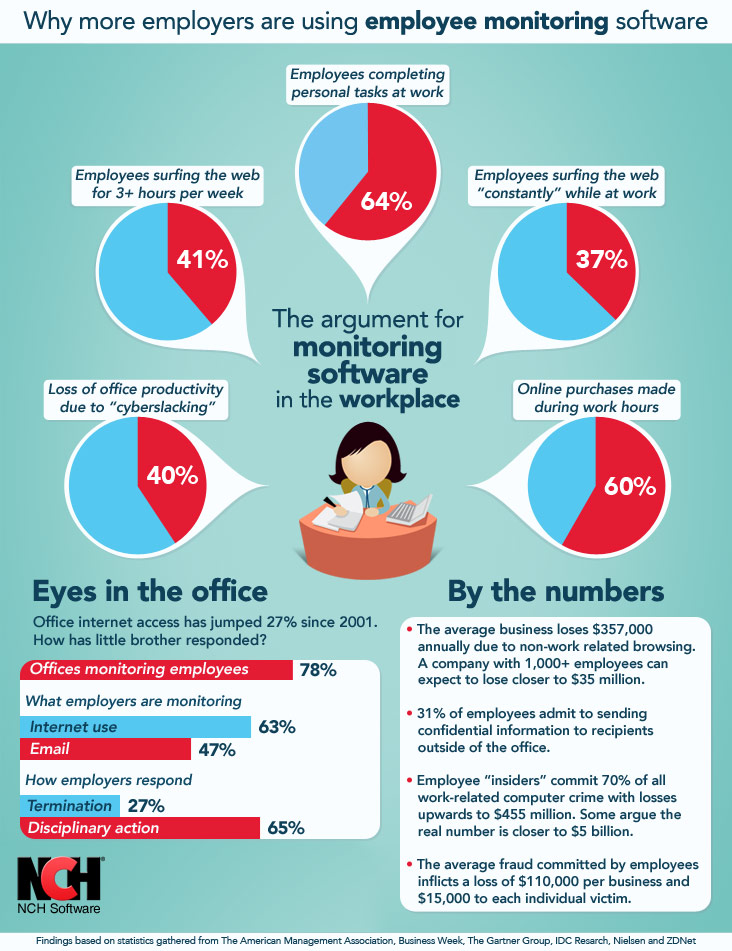
Employee Internet Use in the office, why more companies are using computer monitoring software

Are you reading this blog at work? It's a fair question when you look at the statistics of how many "cyberslackers" there are out there: a new breed of employees who use company internet connections for personal use.

The internet has completely changed the business landscape over the last 10 years, and with it, the day-to-day roles of employees. As more and more of us have begun engaging with the internet’s information playground on a daily basis, there is the increasing temptation to get your Facebook fix before you hit those spreadsheets. With all the benefits the internet affords businesses, the trade-off is a loss in employee productivity which, in turn, can result in a loss of company profit. To combat this potential downturn, many businesses are taking measures to keep tabs of their employees on the clock, monitoring computer usage, emails, phone calls, and even keystrokes, all in the name of retaining employee productivity. When you think about the potential losses (upwards of $350,00 per business), it begins to make sense, even though if you listen closely enough, you can hear George Orwell crying somewhere far, far away.

In the interest of putting employee internet usage into perspective, we've put together the above infographic. If you're interested in the potential benefits of monitoring your employee's computer use, then take a look at FlexiServer attendance software and download the free trial to test drive the computer-use monitoring features.

Now get back to work!

Saturday, March 20, 2010

How VoIP Can Help You Save

How VoIP Can Help You Save At this point, everyone knows someone who is using VoIP instead of a regular phone line. But for those without any experience with VoIP, the idea of switching over can seem like a daunting and risky task despite all the companies and users out there touting the benefits. VoIP has a negative stigma to overcome—during its early use calls weren’t always reliable and the quality was often poor. But the technology is constantly improving, and it has become a viable option for companies looking for innovative ways to save.

Not only will VoIP save you money, but using it can potentially make your business more functional—giving you new opportunities to increase your productivity and responsiveness. While actual cost savings will vary, with a reliable softphone like Express Talk, the savings for small businesses can be significant.

Cost Savings
Here’s an example: say a small business has six employees at one location, and several more employees working remotely. For the main office, the telephone line and long distance charges using a traditional PSTN landline phone system could cost about $180 per month, according to some Verizon statistics. Add to that the cost of the additional phone lines for the “virtual” employees not onsite. Regular phone lines for these freelancers usually run from $39.99 to $100 per month, plus taxes, making the monthly phone bill for this business as high as $780 per month.

Compare that to the cost of using a multi-line VoIP system, where the total cost can be as low as $3.25 to $4.30 per-month, a savings of more than 90%! At those prices, the switch to VoIP can pay for itself very quickly.

Functionality Boost
Another one of VoIP's biggest benefits is arguably increased functionality. The Yankee Group estimates that small to mid-sized companies who use VoIP systems are 25% to 35% more responsive to customers.

This increase is attributed to the convergence of voice and data, giving users one centralized system for managing messages sent by phone, fax, email, and cell phones. Reducing the number of channels that need to be handled separately makes checking and responding to messages a more efficient process, so more messages can be answered.

Learn More About VoIP
This is just the beginning. There is a lot more information about VoIP, and if you want to learn more here are several online resources you might want to check out:

Monday, February 22, 2010

Making a Case for Telecommuting

I am currently working towards my MBA, and this semester I'm taking an information systems class online. As with all the classes I've taken I try to find a way to relate what we're discussing in class to my life and my job to help make the lessons both more interesting and more useful.

Making a Case for Telecommuting Last week the connection between what we were talking about and work was immediately apparent. We were given a group assignment to develop a plan for a group of employees trying to convince management to allow telecommuting, a request they had flatly refused in the past. FlexiServer Team Management Software is one of our business applications that is designed to track the attendance and computer usage of employees, making it an ideal solution for managing remote employees, so naturally it immediately jumped to mind as a potential solution to overcome management objections. FlexiServer would allow for telecommuting while addressing answering one of the large concerns management might have, how to accurately track the hours and productivity of the telecommuters.

Managers don't want to end up paying an employee for surfing the internet all day and not getting anything done. And there is a concern that this is what will happen when the manager can't see what an employee is doing. Fortunately real-time technology tools for employee tracking not only open the door for telecommuting, but can offer a solution for this concern as well. Using software like FlexiServer allows managers to see reports on employee hours, application use, or optionally screenshots of the employee's computer; giving managers greater peace of mind that work is still getting done.

Also important for the telecommuter, who might be using a personal computer, is the ability to log in and out of work-mode. This allows the employee to log-on when they are doing work related activities to have their hours tracked, and then log-off during non-business hours and not need to worry about their personal computer use being tracked. Similarly, in an office an employee can switch to a private-mode during a break to do something like checking their bank account without worrying about the session being recorded by Flexi or seen by management.

For the assignment, my group chose to use an interrogatories technique. What that boils down to is compiling a comprehensive list of all the possible questions management might have about allowing telecommuting. Questions, such as why the staff wants it to what other companies have in place, to how it could be achieved. Then when you have the list you go through and answer them all in order to help persuade management that telecommuting is a viable business plan despite their initial misgivings. I think that FlexiServer Attendance Software is an answer to one of these big questions, how to manage and track hours of remote and telecommuting staff.