Showing posts with label recording. Show all posts

Thursday, October 31, 2013

MIDI Recording and Editing

midi software recording, editing and mixing Did you know that built into our MixPad multi-track recording and mixing software is a MIDI editor that gives you precise control of MIDI tracks?

What this means is that you can record from MIDI instruments and devices, then edit those tracks, adding or deleting notes, adjust the pitch and duration of notes. Even quantize and humanize your MIDI creations adding small amounts of variability to the track so it sounds less like a robot and more like a musician. All of this with support for VSTi instruments and the standard MixPad features giving you the ability record and mix multiple audio tracks, add audio effects and more, expanding the power of this comprehensive sound studio software.

Saturday, October 26, 2013

Catch A Ghost On Tape

In honor of Halloween, we are taking a quick look into the paranormal world, and the recording and analysis of Electronic Voice Phenomenon (EVP). With all the little ghosts and goblins about you may want to have a little seance or just listen to the beyond.

EVP Recording
You don't need to be a ghost hunter to try recording an EVP, although being open, polite, and respectful are believed to be factored in success. Here are some tips to help you get started:
  • Equipment. You need an audio recorder, a headset for when you analyze your recordings, and a touch of patience that couldn't hurt.
  • Start somewhere quiet. You don't need to be in a "haunted" location to make your recording, and while some believe background/white noise may encourage paranormal voices when you are just getting started the more traditional quiet location will make analysis easier.
  • Recording. Take note of the noises around you as you record so you can rule them out when you analyze the audio later. Also, be sure that you do not have voice-activated recording turned on.
  • Ask Questions. One of the most common techniques is to introduce yourself and then ask a series of questions as if you expect a response, with pauses between questions for replies.
  • On to the Analysis. When you are done recording it's time to listen for EVP messages.

EVP File Classification
EVP Recording and Analysis There are three classifications of EVP recordings based on their clarity, and the type of recoding you have will also affect the amount of editing you will need to do. The Classes are:

Class A:  A voice that can be understood without needing headphones and there is general agreement on the content.

Class B:  A voice that requires headphones to hear and not everyone can agree on its content.

Class C:  A voice that requires much filtering and even by wearing headphones nobody can agree on its content.


Analyzing EVP Recordings
The first step is to listen to the original recording from start to finish, making note of when you hear something. Before you start isolating and editing, be sure to save a copy of the original file so you can always go back, or allow people to compare the files.

Chances are you will need to do some audio editing—enter WavePad—to better hear the EVPs on your recording. If you are planning to share your findings remember that the more editing you do the more possible criticism you can get from skeptics. First, you will want to trim the audio file to the sections you took note of. Then common editing done includes amplifying those hard-to-hear sections, possibly removing background noise, and slowing down the EVP since they are often spoken very quickly.

Of course, this is a very cursory look at Electronic Voice Phenomenon, but if you are intrigued by the topic here is a brief list you can explore to learn more and find additional advice on recording and analyzing EVPs from some ghost hunting pros: Or, if EVPs don’t fascinate you, you can always capture your little gremlins in their costumes on film instead. We have software to help you memorialize the holiday that way too.

Friday, October 11, 2013

Pocket Dictate for Android is Officially Here

new android dictation app It has been asked for repeatedly, and some of you may have started to lose hope, but the brand new Android version of Express Dictate has finally arrived.

Doctors, Lawyers, and other professionals will be glad to have the easy dictation-recording app on their Android phone, complete with HIPPA compliant encryption for keep client information safe when you send recordings off to be transcribed.

Transcriptionists too will want to take note of this wonderful new portable option for recording to recommend to clients.

We are really excited to have this Android dictation app available and we are only sad that we didn't get it into your hands sooner.

Monday, October 7, 2013

Do More with Audio - Blog Carnival October 7, 2013

Here are this edition's entries to Do More with Audio:

Erik Matlock presents Another fine fiasco | The Art of the Soundcheck posted at The Art of the Soundcheck, saying, "War stories from the pro audio world. This time, we are running a show where the rig has been rented from several different vendors. What could go wrong?"

Tim presents Acoustic Guitar Recording posted at Deacon Tim’s Audio Blog, saying, "Recording a great-sounding acoustic guitar track used to be a real challenge, but with today’s highly affordable hardware and software, you can have the power of a pro studio right in your computer on your desk.

Jon Tidey presents Tips For Recording Great Electric Guitar Without Amps posted at Pro Sound Web, saying, "With direct guitar recording into virtual amps you can rock out through a great guitar chain without the neighbors calling the cops. This article outlines a few tips and best practices for getting great guitar tones without amps or mics."

Marie Tueje presents SFX Independence posted at Designing Sound, saying, "A list of new SFX libraries that came out in September and are available to purchase/sample now."

Casie lane presents Electronic Music Labels Using Pinterest posted at DJ Casie Lane.

Assap presents Isolated EVPs mystery posted at The ASSAP Blog, saying, "Why do the most convincing EVP recordings all seem to be single words or short phrases with little or no accompanying noise?"

Lilach presents How, What, Where and Why Guide to Podcasting posted at Socialable, saying, "Have you ever considered starting your own podcast? Anyone with a computer and Internet access can start their own podcast, so get your microphones ready and check out these tools to help you get started." John Lee Dumas presents 3 Unique Ways to Get Started With Business Podcasting posted at Social Media Examiner, saying, "There are many ways to approach business podcasting without interrupting your schedule, budget and skills."


You might also be interested in: That concludes this edition of Do More with Audio. If you have an audio story to share or advice, tips or tricks to share, we hope you will submit your audio posts and articles to the next edition.

Wednesday, September 25, 2013

Teaching Reading Fluency With Podcasts

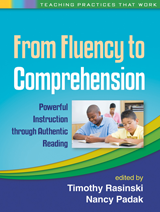
Book About Teaching Reading Fluency We were excited to hear about the newly published book, From Fluency to Comprehension, part of a Teaching Practices That Work Series. Not only is this an important topic and a resource full of practical information for teachers, we first heard about this book from Sheri Vasinda and Julie McLeod who wrote one of the chapters on podcasting approaches to reading fluency. In that chapter they feature the Pocket WavePad mobile application, complete with illustrations, for recording and emailing scripts.

So if you are an educator or parent of a young reader, take a closer look at this new book about building the skills students need to read accurately, meaningfully and expressively. This guide incorporates activities, examples and technology—like our very own WavePad—to provide students with the essential components of reading comprehension. A fundamental skill for learning, and as someone who strongly believes in lifelong learning, a cause I am happy to see us support even in the littlest of ways.

Tuesday, August 6, 2013

Do More with Audio - Blog Carnival August 5, 2013

Here are this edition's entries to Do More with Audio:

Erik Matlock presents Stuff you should know about your first recording session posted at The Art of the Soundcheck, saying, "Ongoing blog written for the new guys. Recently picked up and promoted by prosoundweb.com"

Stephanie Ciccarelli presents Audio Editing: From Razor Blades To Keystrokes posted at Audio Daily, saying, "Having come from the dark ages of radio production, digital audio production has been the most significant advance to me. The problem has been that audio recording software is mostly designed for music recording, so what's a voiceover artist to do?"

Susan Kaye Quinn presents How to Make a Book Trailer posted at Susan Kaye Quinn: Speculative Fiction Writer, saying, "The key to a good trailer isn't cameras and dollies, but story and execution. It has to WOW on an emotional level, and the only thing that turns those gears is a story well told. This should sound familiar; these are the things that make a good blurb, a good cover, a good movie, and a good book. And what better way to promote the audiobook than a sample of the narration?"

Jessica Clark presents 10 Phenomenal Musicians Named Ken posted at Kenney Myers, saying, "Musicians who share the name “Ken” are a dime a dozen. However, there are a select few who have made a significant impact on the music industry, and it is they who deserve special recognition."

Corey Walo presents What’s All This Noise About Dither? posted at ProSoundWeb, saying, "Unless you've put some serious effort into learning to master your audio, the concept of dither can be fairly bewildering. We've all been told to “do” it, but what are we actually doing?"

You might also be interested in: That concludes this edition of Do More with Audio. If you have an audio story to share or advice, tips or tricks to share, we hope you will submit your audio posts and articles to the next edition.

Friday, July 26, 2013

Why Do High Sample Rates Sound Better?

Guest post by Rupert Pfaff

Human hearing is generally defined as extending from 20Hz to 20kHz, and the Nyquist criteria state that a sampling rate of at least double the highest audio frequency must be used in order to accurately represent the signal. An unwanted side-effect of analog to digital conversion is 'aliasing', where musically unrelated signal noise enters the audio band, so an 'anti-aliasing' filter is used to prevent this, but because it is not possible to implement an infinitely steep filter, a slightly higher sample rate is used than is theoretically necessary. This is how the CD standard of 44.1kHz came about (a little more than double 20kHz), and DAT took this up to 48kHz to allow varispeed recording.

Set audio sample rate in WavePad audio editing software So if we can't hear above 20kHz, why record at very high sample rates such as 96kHz or even 192kHz? Some have suggested that although we don't actually hear 'supersonic' frequencies, we somehow perceive them by another means, but experiments that artificially add and remove these frequencies have shown this not to be the case. But 'golden eared' tests which have made A/B comparisons of the same equipment operating at standard and high sample rates have revealed that 96kHz & 192kHz recordings do sound subjectively better - so what's going on?

The answer lies primarily with the anti-aliasing filters - even the best-designed filters produce a certain amount of 'ripple' that extends downwards from the cut-off point and gradually tails off, and this is perceived as a 'smearing' of high frequencies and the stereo image. But by moving the cutoff point way up (say to 96kHz), the ripple has all but disappeared by the time it gets down to audio frequencies, and hence, substantially improved sound quality. Importantly though, it follows that this improvement is maintained even after the sample rate has been converted down to normal rates, as no new A/D conversion is required, and therefore, no anti-aliasing filter.

Experienced Recording Studio Engineer Guidelines
In the early days of high sample rate recording, there was a preference for using multiples of the 'CD' frequency (44.1kHz), i.e. 88.2kHz or 176.4Hz - this was because sample rate conversion was a very difficult thing to do at the time, and better quality could be achieved when converting down to 44.1kHz by using an integer multiple. However this is no longer the case, and our usual preferred rate for acoustic recording is 96kHz for a variety of reasons:
  • 96kHz is the native frequency of many DVD audio releases
  • Although 192kHz does sound a little better than 96kHz, the improvement is marginal
  • Some plug-ins do not handle 192kHz audio
  • Processing power is reduced to roughly a quarter of that available at 48kHz
That said, if you are working very largely with virtual instruments that have mostly only been sampled at 44.1kHz, and/or you like to use a lot of tracks and processing, it may be more sensible to stick to 44.1kHz. Or if you're making a small classical or jazz recording, you may only need a few tracks and little processing, and want to eke out every last bit of quality you can, then go for 192kHz - let your music make the decision for you.

Rupert Pfaff has worked in the music industry for over 20 years having operated a well known music shop in London before becoming a sound engineer and technical authority for mixing and mastering. Now involved with the day to day running and managing the online bookings for RecordingStudioLondon.

Thursday, July 18, 2013

Trends in Voice Over & the Affect on Audio/Video Production

Guest post by David Ciccarelli, CEO & Co-Founder of Voices.com

The art of communication - the most powerful, persuasive, and distinctly human tool in any marketer’s arsenal - has evolved to the degree that you don’t have to be in the same room to get a message across, or even be in the same country for that matter.

With this advancement, making sure the audience receives, understands, believes, and acts upon your message is so important. Hiring a voice-over artist with good acting skills (listen to podcast) can ensure your video production achieves the desired response.

Trends in Voice Over Audio Production Voice actors play many different roles, each one representing a different purpose and segment of voice-over work. Commercials, entertainment, business and educational videos are just some examples of where you’ll hear voice-overs.

With the rise of social networks over the last decade, it’s become clear that we trust the recommendations of friends and family members. It’s for this reason that one role has risen above the rest among video producers looking to have their stories told in a persuasive, trustworthy manner.

Introducing the Real-Person
Projects requiring a more casual approach often benefit from relatable, genuine voice-overs. These are referred to as real-person voice-overs, often cast as “the regular guy” or “the girl next door.” The character is homegrown, sensible, and friendly with a touch of familiarity. This provides a more intimate interpretation of the message and instills trust with the audience.

You’ve probably heard the real-person in commercials, podcasts, explainer videos, and any other application where the voice actor needs to speak as though he or she is having a conversation with the listener.

By their very design, these types of reads sound natural and connect with the audience in a more direct, affable way.

Becoming More Conversational
In order to get that real-person read, the voice actor needs to sound informal and genuine. This can be more difficult than one might expect. It takes discipline and practice on the part of the voice actor to sound like they’re having a conversation rather than just reciting the message. This is where good direction comes in.

These tips will help you get the conversational read you’re looking for. Ask the voice actor to:
  • Speak Slowly. Reads come across with greater sincerity when spoken at a slightly slower pace. When people rush through their words, they can either sound like they’re hiding something or that what they have to say is more of a sales pitch. Although this is true, you may find that commercials don’t afford you the luxury of reading slower because they contain too much copy to read at a slower pace. Commercials require that the voice actor reads the copy within the time allotted for the spot. Keeping a steady metronome-like tempo gives the voice actor the freedom to massage each and every word and give it the proper attention it deserves while observing punctuation and places to breathe.
  • Speak Naturally. Reads are more conversational when they don’t sound as if the words or dialogues are contrived, meaning that it’s deliberately created instead of arising naturally. The trick to a conversational read is to have the voice actor picture themselves speaking to a friend or family member while reading their lines. With that, a more conversational flow to the read should occur.
  • Sound Authentic. Sounding authentic is an important aspect of delivering a real-person read, although doing so isn’t easy, especially when you’re recording a commercial or a piece that involves persuasion or the selling of an idea. Authenticity is important in voice acting because the listening audience needs to feel that what you’re telling them is true. To be authentic, make sure the listener will feel as though the voice matches the role.
Trying Out the Real-Person on Your Next Video
When hiring a voice actor to narrate the script of your next video, consider giving them the artistic direction described above. By doing so, your video will be more persuasive and encourage the viewer to take your desired action.


David Ciccarelli, CEO / Co-Founder of voices.com About the Authors: Stephanie Ciccarelli and David Ciccarelli are the founders of Voices.com, the largest global web hub for voice actors. Over the past nine years, Stephanie, David, and their team have grown Voices.com from the ground up to become the leader in the industry. This article was originally published in Voice Acting For Dummies and has been republished with permission from John Wiley and Sons, Inc.

Saturday, July 13, 2013

Recording A Video Audition

Record Video Audition Tape and Contest Entries From becoming a YouTube star to entering contests held by talk shows, to sending in a video audition to become a game show contestant or star of a reality tv show, opportunities to use videos to help you find your fifteen minutes of fame are all around you. But with video recording and editing technology so prevalent, there is also a huge amount of competition. So, it is important to make a lasting impression with what limited time that you have.

To help make sure you shine in your audition roles, here is some advice for creating an audition tape for all of our VideoPad video editor users and friends.

Eliminate Distractions
Many of the tips for entering video contests we mentioned back in May can apply to video entries to other types of competitions as well, but instead of selling a story, you are going to be selling yourself. And instead of editing a script to cut out anything not important to the central story, you will instead need to cut out things that could distract the judges from that star of this short film—you. Most of the advice below is centered on this idea of eliminating distractions, so if you don't take anything else away just remember that you want to keep people's attention on you.

Planning and Preparation
Creating a video of yourself certainly sounds a lot easier, you don't need to craft a storyline, but that doesn't mean you should skip straight to filming. Read over the rules/requirements. What do you need to include? What are they looking for?

While you may not be writing out the story you may still want to write yourself a script or dot points to practice from; like you might use if you were giving a speech. Let's face it, you may not have a big audience while the camera is rolling, but if you do your job well there could still be a large audience who watch your video later on.

Practice, Practice, Practice
Remember practice makes perfect, so practice, practice, practice. While writing out notes when you're getting ready will help you prepare, you don't want to stand in front of the camera reading from a piece of paper. Make sure you know what you want to cover in and out. Don't be afraid to film multiple takes and pay particular attention to filming and editing below to make sure you have a clean video to send in.

Be Yourself
Filming multiple times may also help you get any camera-shy nerves out of your system. You need to know what you want to say which is where the practice will help, but those nerves can sometimes make you stiff. Practice several times with the camera rolling to help you feel natural even with the red light on so that people will still see you and your personality, not just a robot regurgitating a script. It may be easier for some, but you want to come across as genuine.

Location, Location, Location
One thing that can hurt your chances but is easy to control is the setting. With few exceptions, you want to avoid a cluttered backdrop that could distract people away from you. Try recording in front of a plain backdrop like a white wall or a solid-colored door. You can also consider filming at a nice outdoor location, but remember that focus should be largely on you so you want to avoid areas where there will be distracting sounds or commotion like traffic or people walking by. Filming outdoors could also make getting clear audio a bigger challenge depending on your device(s), so be prepared to need to do some audio editing with WavePad in addition to working with VideoPad.

Polish With a Little Video Editing
Editing your video shouldn't be an arduous task. The point of editing is just to polish off what you have already done. Cut out mistakes; make sure you are meeting any time requirements. Maybe add in a photo or two, but don't be tempted to use every effect at your disposal. Any editing you do should be to help you talk about and sell yourself. Keeping it simple is in your best interest.

For some help getting started and learning the simple editing basics, see our post on video editing tips and tricks and the VideoPad video tutorial.

Hopefully, these tips will help you stay focused as you record and edit your video audition tapes. Most importantly have fun and good luck!

Tuesday, June 4, 2013

Do More with Audio - Blog Carnival June 4, 2013

Here are this edition's entries to Do More with Audio:

Denise Thompson presents How to Choose the Best First Student Guitar posted at Find A Babysitter, saying, "Learning to play a musical instrument allows your child to strengthen a wide range of their auditory skills, benefiting her throughout her adult life if she continues to play."

Björgvin Benediktsson presents Methods For Recording Acoustic Guitar posted at audioissues, saying, "Recording an acoustic guitar requires different methods recording an electric guitar."

David Thompsonn presents Exploring the Merits of Children Learning to Play an Instrument posted at Backup Care, saying, "Once a child reaches middle school, the school will often offer orchestra or band as an elective class. If your child isn’t particularly driven or musically inclined, why would you want to encourage him to play an instrument?"

Peter Kirn presents Music for Dance, Music and Movement posted at Create Digital Music, saying, "Movement and machines are the reason I do what I do, exploring new sounds in a way that is human and gestural."

sigh presents Sounding a Social Game posted at Behind the Scenes of Lucky Lady Games Studio, saying, "So now that all the essentials of the Lucky Lady Casino is arted up & in production, we have focused our energies towards another sensory must-have in game design, sound!"

Jenifer Sarah presents Jet Audio free download latest version of MP3 player 2013 posted at Software Collection, saying, "Jet Audio free download is one of the smartest Mp3 player available on the internet. You can play your all audio and video files with this latest version of Jet Audio free download. The best thing about this Jet Audio free download is that you can also convert your favorite video files into many formats. The audio controllers provided in this version of Jet Audio free download are amazing."

You might also be interested in: That concludes this edition of Do More with Audio. If you have an audio story to share or advice, tips or tricks to share, we hope you will submit your audio posts and articles to the next edition.

Friday, May 24, 2013

WavePad Now Available for Android

WavePad Android Audio Editing App The long time NCH favorite, WavePad Sound Editor, is now available for Android phones and tablets. With releases of the popular, easy-to-use audio editor already available for Windows, Mac, iPhone and iPad we are extremely excited to round things off with the Android version.

Like the other versions, the WavePad Audio Editing Android App provides the same easy audio recording and editing tools you want, simply on another platform. So no matter what your preferred operating system is, or if you are at the desk or on the road, audio enthusiasts everywhere can rely on WavePad Audio Editing Software to be there to record and edit music, interviews and other audio.

Wednesday, May 8, 2013

Video Competition Tips & Advice

VideoPad Video Editing for Video Competitions Ready to take your videos beyond home movies? For VideoPad users who are ready to showcase their creativity and videographer skills, we've put together some advice and resources for getting your videos ready to compete.

There is a wide range of video contests out there, put on by all kinds of companies and products, in a variety of themes. The smaller contests will have smaller prizes, but they will also have less competition, so they are still worth considering. To find a contest that appeals to you here are a few sites to explore: Once you have a contest picked out the real work starts. Be sure to take your time and do your due diligence instead of jumping straight into filming.

Do Your Homework
Make sure that you read the rules and judging criteria carefully. Knowing how a winner will be chosen will help you make a video that will fit the bill.

Scripting and Story Line
Having a good story is key, so take the time to brainstorm until you have a story you are confident in. You want a moving story that fits in with the contest theme and connects with the viewer. Humor is often one way to draw people in, but it isn't always easy to pull off and certainly isn't the only option. You can tug at the heartstrings or appeal to people's sense of justice, etc. The goal is always to create a story people will want to watch through to the end.

Practice and Timing
Since you will almost always have a time limit, you need to make sure you can take your story from beginning to end in the time allowed. With a limited amount of time, subplots and tangents should be scrapped, and you need to grab your audience in the beginning. You want to start with a strong hook, and keep things moving through the conclusion. When reading through your script and practicing, you should not only make sure you are familiar with the dialogue, working on making it sound natural and animated, you should also be testing how long it takes to read through. Does it fit within the video time limitations? As you go through this process you should think about if there are any awkward phrases you should remove, or other edits to either cut down the length or help with the rhythm of your story and keep things moving forward.

Sponsors
Depending on who is sponsoring the contest you may want to try to work them into your video. Maybe use one of their products as a prop or have it in the background. If they are doing the judging this could earn you some brownie points, but don't force it if it really doesn't make sense with your story.

Dialogue and Audio
Audio quality in your video matters. It is an important part of a film as a whole, and poor audio can detract from a film and cause people to lose interest, so don't forget about the audio. Dialogue should sound natural and animated, which can be a challenge both in writing and performing, as well as in the recording. You should strongly consider using an external microphone for recording high-quality audio. You want the dialogue to be easy to hear and understand and have a consistent volume between shots.

If you do use the built-in microphone on your camcorder remember you can still separate the audio from the video so you clean the audio, remove background noise, normalize and make other adjustments. For a closer look at some important audio editing features, you may want to use, see our list of WavePad audio editing tips and tricks.

Adding Music
Adding music to your soundtrack can help draw the audience in, but be sure to balance the volume with any dialogue. And make sure that you either get permission before using copyrighted music from the publisher or steer clear of copy-protected music altogether and use royalty-free music and original works. You may be required to provide proof of copyright/permission for the audio in your video with your submission; using copyrighted music without permission can not only get your video disqualified, but it can also cause legal problems, so getting and sending proof of permission for a piece of music is in your best interests.

Filming and Editing
Important things to remember are that you want to maintain sharp focus and limit the amount of zooming and camera movement. Consider using a tripod during filming. Shaking can be removed from video using video stabilization, and if you are using handheld camcorders or cell phones this will be a necessary step, but using a tripod will eliminate the need for stabilization in editing.

For a closer look at some more VideoPad editing features you may want to use, see our post on video editing tips and tricks, but remember you want to entertain the audience, not to make them nauseous. Excessive camera movement or overdoing the effects can be distracting, and like everything else you want the transitions and movement to support the story, not draw attention to itself.

Double Check Everything
Before you send in your video be sure to double-check everything. Did you follow all of the guidelines? Is the movie saved in the correct format and does it meet the time requirements? After all of the work you put in it, you don't want to have your video thrown out because you forgot something. If you will be submitting your video on a DVD, do not include menus unless they were asked for. The judges will be watching hundreds of entries, so this is another case where time matters and they will want the video to start playing automatically.

Submit Your Video
When you're sure you have dotted all your i's and crossed all your t's send in your submission. If it is being judged by the community be sure to let your friends, family, and colleagues know to check it out and vote for you, otherwise it will now be out of your hands. But win or lose, you should have a video you are proud of.

If you have any more advice to share please comment, and Good Luck with your videos!

Wednesday, January 9, 2013

Speaker Recording Software for Windows and Mac

Speaker Recording Software to record audio from speakers Everyone knows you can use a microphone for recording audio, and a quality microphone is the best tool for a lot of different types of recording, but if you want to record something that you are listening to on your computer putting your mic next to your speakers is not going to get you the quality audio you can get with SoundTap Streaming Audio Recorder.

With SoundTap you can directly record audio from your computer, so you are capturing the same audio you hear being played through your speakers and saving it as an mp3 or wav file. So, with SoundTap installed on your PC or Mac you can record high quality digital audio from all kinds of places including:
  • Record internet radio streams
  • Convert formats with their own players to mp3
  • Record VoIP phone calls or conference calls
  • Save audio from streaming webcasts
  • Grab the audio in online videos
And the list continues, so download SoundTap today to record sound from your computer and happy recording!

Wednesday, December 5, 2012

WavePad's Chicago Fire Cameo

Did you spot WavePad on the NBC show Chicago Fire? If you're a fan of the new NBC show Chicago Fire and you have sharp eyes you might have spotted WavePad on the recent Two Families episode that aired on November 21st. For those of you not familiar with the show it is an intense look at the lives of the firefighters and paramedics Chicago Firehouse 51. One of the subplots of this rather intense Thanksgiving episode includes one of the firefighters deciding to put together a podcast, and there is a scene with him doing an interview with another one of the station 51 firefighters. As they are talking if you are familiar with the WavePad interface you might recognize it in the computer sitting on the table between them. For us this was an added excitement to add to the already action packed television show.

If you haven't seen it you may very well want to start following the heroes portrayed in Chicago Fire. And if you want to create a podcast of your own you will want to have WavePad Audio Editing Software on your computer.

Friday, November 23, 2012

Best Software for Making Music

Award for MixPad Multitrack Audio Software
Software Review Boffin recently reviewed MixPad multitrack mixing and recording software, adding it to their list of music making software titles. In the review they praised not only MixPad alone for being exceptional software, but noted that "the [high] standard is consistent with other NCH products that Software Review Boffin has audited before." The review also went on to say:

"With MixPad Multitrack Recording Software users are able to record instruments and vocals for their music production. Users will find it simple to rearrange, copy and integrate music to the intended state the user desires. Create audio productions within minutes of downloading is a great start for music making software."
  – Software Review Boffin

You can read the complete review of MixPad music mixing software from Software Review Boffin, or download MixPad today to test out the multi-track recording and mixing features for yourself. Also be sure to check out our other exceptional and award-winning, audio software or musician software titles for additional music making tools.

Friday, November 2, 2012

Record Skype Calls - Easy Audio & Video Call Recording

call recording software We have posted before about recording phone calls through a TRX personal call recorder, recording multiple phone lines across a business network with VRS call recording software, or even saving conversations with the Express Talk softphone’s recording feature, but with the advent of internet technology like Skype, what if you want to record a phone conversation on your computer?

Record Skype Audio Calls
The solution to recording your voice-over-IP calls is our SoundTap streaming audio capture software. With SoundTap you can record any audio that is played on or through your PC or Mac, making it easy to record both sides of your conversation; instead of only your microphone input. It is akin to tapping your virtual phone and you can save the audio in .wav or .mp3 format.

Record Skype Video Calls
For video, we suggest you turn to Debut streaming video recording software. Debut is a powerful video capture program that can grab video from virtually any source, including your screen. Make sure your Debut options are enabled to record both video and audio, and then you can easily record your video calls, including Skype, to play back or edit later.

Saturday, October 20, 2012

Software for Radio

Radio SoftwareWe already past 'R' in our A to Z software tour, but as a honorable mention after recording, here are a number of professional radio programs designed for specific tasks to help the small or start up radio station or podcaster. So if you are interested in creating or hosting your own audio content be sure to check out these radio applications to help you along the way:

BroadWave is an audio streaming software program designed to broadcast any audio connected to the sound input on the PC. It will also stream audio recordings and all BroadWave streams will play directly from the default web browser on any modern Windows or Mac computer.

VRS is a professional voice recording application that can be used radio station logging, recording multiple audio channels simultaneously with digital signal processing, automatic level control and a continuous recording mode to easily save a copy of all your broadcasts.

From recording to editing and mixing your audio, interviews, music and voiceovers you won't want to be without our favorite duo, WavePad audio editor and MixPad multitrack mixer both are available for your Windows PC or Mac, and for recording and editing on the go you can also download Pocket WavePad on your iPhone or iPad, perfect for those coffee shop interviews and more.

Want to share a snippit of audio from something else online with your listeners? Save streaming audio as an mp3 or wav file on you computer with the use of SoundTap streaming audio recorder to rip the audio you hear playing on your computer. And you can always visit our full arsenal of radio software for additional radio tools and applications.

Monday, October 8, 2012

Something to Talk About

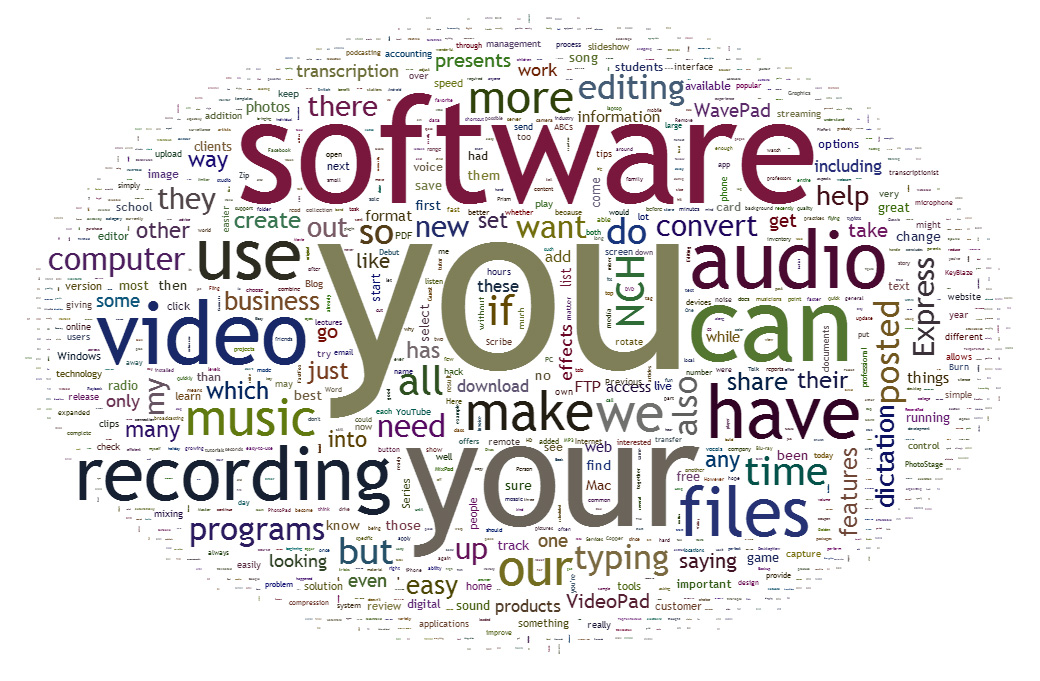
Below is a word cloud generated from our posts here on the NCH Software: Do More with Software blog. There is no real surprise that we talk a great deal about "you" and "software," but is there anything you would like us to write about and cover more in the future?

NCH Software blog word cloud

Monday, September 17, 2012

R is for Recording Software

NCH Software ABCs Series

R is for Recording Software Recording is another commonly needed feature. If you are anything like my family you have lots of things you save and hold on to and recording software is just one way to create digital copies of things you want. From recording voice overs and audio dictation to music and videos we have the software that you need. Whether you are digitizing a recording you have on another media, like a vinyl record or VHS tape, or recording something brand new, browse our complete recording software collection for the program perfect for your recording needs.
<<< Previous: Q is for QuickNext: S is for Sharing >>>

Tuesday, May 15, 2012

The TIVO of Internet Recording

internet video recording softwareOne of the great things about TIVO is that you schedule recording times and then you don't need to worry about missing your favorite show. Since Debut video recording software is perfect for capturing all digital video from, streaming video to video of your screen, you can easily turn Debut into a personal internet recording TIVO system by schedule recordings for when you are away from your computer.

Start by setting up your recording as you normally would by selecting your screen for the input, and setting the recording area. Then click the Schedule button followed by Add to set the date and time for your new scheduled recording. Once those details are saved all you need to do is make sure you leave the window or website you want to record cued up on your screen so it will be recorded at the appointed time. When you return the recording(s) can be found in the Find & Play list by clicking the Recordings button on the toolbar.

If there is something that you want your computer to record, while you are sitting at your desk or while you’re away, download Debut screen capture software today.